
AI engines now answer a large share of searches before anyone clicks a link. Generative Engine Optimization (GEO) and Answer Engine Optimization (AEO) are how your content earns a place inside those answers. Drawing on a recent GEO and agentic commerce workshop where I spoke, here is how AI search actually selects sources, what makes content get cited, and why your hosting plays a bigger role than most teams expect.
I lead SEO at InMotion Hosting, and I recently presented at the AI in Retail: GEO & Agentic Commerce Workshop hosted by Doing Business in Bentonville alongside teams from NWACC and Google. The room was full of brand and marketing leaders asking one version of the same question: if AI gives the answer, how does my site stay in the conversation? This is my attempt to answer that clearly, from the perspective of someone who watches both search behavior and server behavior every day.
What Is Generative Engine Optimization (GEO)?
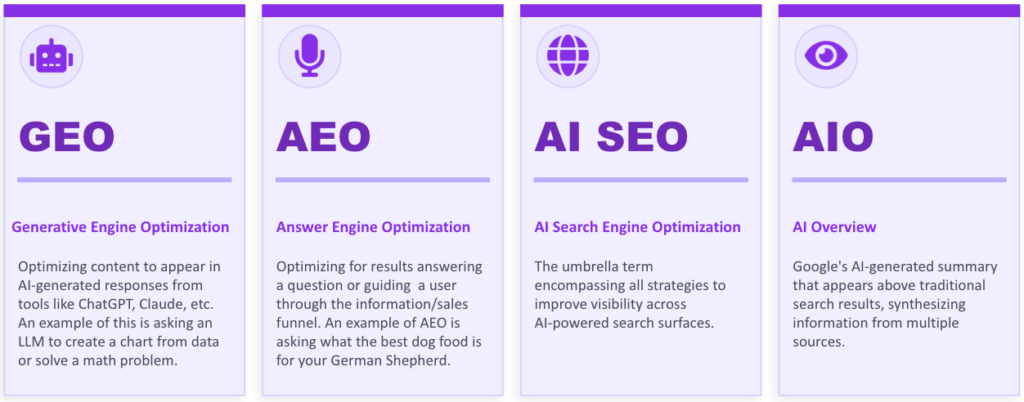
Generative Engine Optimization is the practice of structuring content so AI systems retrieve, trust, and cite it inside generated answers. The term comes from a 2024 academic paper presented at ACM KDD by researchers from Princeton, Georgia Tech, IIT Delhi, and the Allen Institute for AI, which introduced GEO as the first formal framework for improving content visibility in generative engines (Aggarwal et al., 2024).
The shift is simple to state. Traditional SEO competes for a ranked link. GEO competes for a mention inside the answer itself, in tools like Google AI Overviews, ChatGPT, Gemini, Perplexity, and Claude. The page still matters. What changes is the prize.
How Do GEO, AEO, and SEO Differ?
These three terms get used as if they are interchangeable. They are related, but they target different surfaces and reward different work.
AEO is the bridge. The habits that win featured snippets, clear questions with direct answers, also help you get pulled into AI responses. GEO extends that thinking to a model that reads many sources at once and assembles a single reply.
What the Zero-Click Shift Means for Your Traffic
The reason this matters now is measurable. SparkToro’s clickstream research found that roughly 58.5% of US Google searches and 59.7% of EU searches ended without any click in 2024, and the figure has continued climbing past 60% as AI features expand (SparkToro, 2026). AI Overviews now appear on more than 20% of searches, and when one shows up, click-through rates on the top result drop sharply (SparkToro, 2026).
That surprises a lot of teams who still measure success purely in sessions. A growing portion of your audience now reads your information without ever loading your page. If your content is the source the AI trusts, you keep the brand exposure even when you lose the click. If it is not, you lose both.
How Does Query Fan-Out Decide What AI Cites?
AI search does not look for one page that answers everything. Google introduced the term query fan-out to describe how its AI Mode works: a single question gets broken into multiple related sub-queries that run at the same time, then the results are synthesized into one answer (Google, 2026).
A question like “best managed hosting for a high-traffic store” might fan out into separate searches for performance benchmarks, pricing, uptime guarantees, support quality, and migration difficulty. Different sources can win different branches. Your page does not need to be the single best result. It needs to be the clear, retrievable answer to one of those specific sub-questions.
This is why thin, broad content struggles. A page that says a little about everything rarely wins a branch. A page that answers one question completely, with specifics, often does.
What Makes Content Get Cited by AI Engines?
The Princeton GEO study tested nine content strategies across thousands of queries and measured which ones increased citation rates. A handful moved the needle by up to 40%: adding relevant statistics, citing credible sources, including direct quotations, and writing with a confident, authoritative voice (Aggarwal et al., 2024).
Notice what is missing from that list. Keyword stuffing did not help. Neither did generic filler. The tactics that worked are the same ones good editors have always pushed for: be specific, back claims with evidence, and write with authority. A few practices stand out for most site owners:
Answer the question in the first two sentences. Models extract direct answers far more reliably than buried ones.
Add real numbers and name your sources. A cited statistic is more quotable to a machine than a vague claim.
Use structured data. FAQ, HowTo, and Article schema help engines parse and extract your content with confidence.
Write self-contained passages. Each section should make sense on its own, because fan-out may pull it out of context.
Where Does Your Hosting Fit Into GEO?
Most GEO advice stops at content and schema. That leaves out the layer that decides whether any of it gets seen. AI engines still send crawlers and agents to fetch real pages, and Google has been explicit that its AI features depend on the same foundations as classic search: pages that are indexable, fast, render their content reliably, and carry structured data that matches what a human sees.
Here is where infrastructure quietly decides outcomes. If your server responds slowly, crawlers fetch fewer pages and may render less of each one. If your site is down when an agent visits, you are simply absent from that answer. Time to first byte, consistent uptime, and clean server-side rendering are not cosmetic anymore. They affect whether your best content makes it into the retrieval pool at all.
This is the part I care about most as someone who works at a hosting company. A brilliant, well-cited article on a slow or flaky host is a missed citation waiting to happen. Managed hosting on a tuned stack, a credible uptime commitment, and the ability to scale to a VPS or dedicated server before traffic patterns shift all protect the technical floor your content stands on. At InMotion Hosting, that floor runs on hardware we own and operate across data centers in Virginia, California, and Amsterdam, backed by a 99.99% uptime SLA and human support around the clock. Content earns the citation. Infrastructure makes sure the citation is reachable.
A GEO Checklist You Can Start This Week
You do not need a six-month project to begin. These steps map closely to what I walked through on stage, ordered by how quickly they pay off.
Audit your content gaps. List the real questions your audience asks that you do not yet answer with authority. Those are your fastest GEO wins.
Add structured data. Implement FAQ, HowTo, and Article schema so engines can extract and attribute your content cleanly.
Refresh your top ten pages. Update stale stats, add citations, and tighten the opening answer. Fresh, well-sourced pages get cited more often.
Add statistics and sources to claims. This single habit had one of the largest measured effects on AI citation rates.
Engage in community Q&A. Reddit, Quora, and niche forums are places AI systems actively pull from. Authoritative answers there build offsite credibility.
Monitor your AI citations. Track where your brand appears in AI responses, the same way you track keyword rankings.
How Should Agencies Approach GEO Across Client Sites?
For agencies, GEO is both an opportunity and an operational headache. You are running this play across many sites, on many hosting setups, each with its own crawl health and rendering quirks. One client’s slow server can quietly cap the results of excellent content work.
Consolidating client environments onto one reliable platform removes a layer of that risk and makes GEO easier to deliver at scale. It is also a service you can package and charge for, since AI visibility is now a board-level concern for the businesses you serve. Our Agency Partner Program is built around exactly this model: standardize the infrastructure, keep performance predictable, and turn hosting from a pass-through cost into part of the value you provide.
What Comes After GEO: Agentic Discovery
The workshop did not stop at citations. A large part of the agenda looked ahead to agentic commerce, where AI does not just recommend a product but completes the purchase on a shopper’s behalf. The throughline is the same as GEO. Machines increasingly act on structured, trustworthy data rather than on keywords, and they verify that a source is real and operational before relying on it.
That is the direction to plan for. Structured content, credible sourcing, and dependable infrastructure are the common requirements whether the machine is writing an answer or completing a transaction.
Make Your Best Pages Easy for AI to Find
AI search rewards the same things good publishing always has, now read by a machine that reads many sources at once. Write specific, well-sourced answers. Mark them up so engines can extract them. And keep them on infrastructure fast and stable enough to be retrieved every time a crawler or agent comes looking.
If you want help making sure your hosting is not the bottleneck in your GEO strategy, talk to our sales team about managed hosting built for performance and uptime. The content is your work. We will keep it reachable.